
Business Plan: Complete Guide, Free Word Templates, Examples & Financial Forecasts
A business plan is a key document for anyone who wants to start, buy, finance, or grow a business. It explains your business idea, your customers, your market, your strategy, your financial projections, your team, and your expected growth.
A good business plan helps you organize your project clearly. It also helps banks, investors, partners, suppliers, and stakeholders understand your business and decide whether they want to support it.
At Consultant4Companies, we help entrepreneurs and companies create professional business plans, financial forecasts, market strategies, and growth plans.
Below, you will find a complete guide, practical tips, simple explanations, examples, and free Microsoft Word business plan templates that you can download and adapt to your own project.
Free MS Word Business Plan Templates and Examples
Creating a business plan in Microsoft Word is a common and practical method. You can use a simple structure, complete each section, and adapt the document to your business idea.
Download the free business plan models below:
Free blank business plan to fill out
Free Small Business Plan Template
Business plan design template with table of contents, executive summary, business description, marketing, finance, and appendix
These templates help you prepare a structured document for banks, investors, partners, or internal planning.
What Is a Business Plan?
A business plan is a written document that describes a business project. It explains how the company will operate, how it will make money, who the customers are, what the market looks like, and how the business expects to grow.
A business plan is useful when creating a new company, taking over an existing company, launching a new product, entering a new market, or looking for financing.
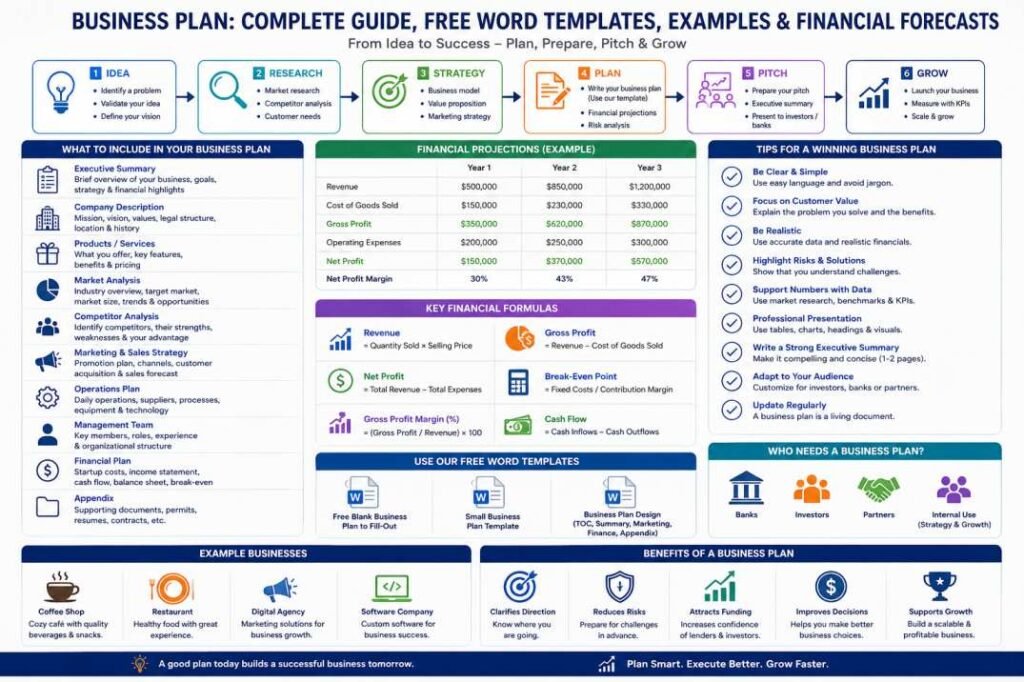
A strong business plan usually includes:
- The context of the activity and its environment
- The target customers and their needs
- The products or services offered
- The business model
- The overall strategy
- The marketing and sales plan
- The management team
- The financing method
- The development plan
- The expected return on investment
- The risks and solutions
- The financial projections
In simple words, a business plan answers three important questions:
- What do you want to build?
- How will it make money?
- Why can it succeed?
When Should You Write a Business Plan?
A business plan should normally be written after you have completed your market research, defined your business model, and decided on the legal structure of your company.
The business plan is not the first step. It is the document that summarizes and organizes all the work already done.
The best order is:
- Find the business idea
- Study the market
- Define the business model
- Estimate costs and revenue
- Choose the legal structure
- Prepare the business plan
- Present it to banks, investors, partners, or internal stakeholders
A business plan is especially useful before:
- Starting a company
- Buying a business
- Raising money
- Applying for a bank loan
- Opening a new location
- Launching a new product
- Changing business strategy
- Expanding internationally
Business Plan vs Business Model: What Is the Difference?
Many entrepreneurs confuse a business plan with a business model. They are linked, but they are not the same.
Business Model
The business model explains how the company will make money. It shows the logic of the business.
For example, a company may make money through:
- Product sales
- Subscription fees
- Consulting services
- Licensing fees
- Advertising revenue
- Marketplace commissions
- Franchise fees
Learn more here:
business model examples
Business Plan
The business plan is broader. It includes the business model, but it also explains the strategy, market, team, operations, risks, and financial forecasts.
In simple words:
- Business model: How the company makes money.
- Business plan: How the company will be built, financed, managed, and grown.
What Is the Purpose of a Business Plan?
The business plan comes after the market research, the business model, and the commercial and operational strategy.
It is important because it allows you to communicate your project clearly. A business plan can help convince:
- Banks
- Investors
- Business partners
- Suppliers
- Distributors
- Shareholders
- Potential co-founders
- Public or private financing organizations
It is also useful internally. It helps the founder and management team follow progress and compare actual results with the original forecasts.
For market preparation, read:
market research objectives, types, and examples
10 Tips for Creating a Strong Business Plan
Below are ten practical tips for entrepreneurs who want to create a useful, clear, and professional business plan.
1. Value the Team
A business plan must present the people behind the project. Investors and banks do not only finance an idea. They also want to know who will execute it.
You should present the skills of the management team and the people in key roles. Explain their knowledge of the market, their business experience, and their ability to manage the project.
You can also mention external advisors who helped build the project. This may include accountants, consultants, legal advisors, marketing experts, or industry specialists.
Related guide:
team work, evaluation, skills, passion, planning, and problem solving
What to Include About the Team
- Team background: Present the experience, education, and achievements of key people.
- Roles and responsibilities: Explain who does what in the company.
- Complementary skills: Show how the team members complete each other.
- Collaborative culture: Explain how the team works together.
- Past successes: Mention previous projects, jobs, or achievements.
- Industry expertise: Show that the team understands the market.
- Professional development: Explain how the team continues to improve.
- Adaptability: Show examples of how the team can solve problems.
- Leadership: Explain how the company will be led.
- Team expansion plan: Mention future hiring needs.
- Employee well-being: Show that the company cares about people.
- Company culture: Present the values and working style of the company.
A strong team section gives confidence to readers because it shows that the project is supported by competent people.
2. Present the Added Value of Your Product or Service
Customers do not buy only because a product is good. They buy because it solves a problem, saves time, saves money, creates pleasure, or improves their situation.
Your business plan must explain clearly why customers will choose your product or service instead of another solution.
Focus on Your Unique Selling Proposition
Your unique selling proposition, also called USP, explains what makes your offer different and attractive.
In your business plan, explain:
- Customer pain points: What problems do your customers have?
- Your solution: How does your product or service solve these problems?
- Key features: What does your offer include?
- Benefits: What real value does the customer receive?
- Customization: Can your offer adapt to different needs?
- Cost savings: Can the customer save money?
- Time savings: Can the customer save time?
- Quality: Is your product stronger, faster, better, or more reliable?
- Innovation: Is there something new or smarter in your offer?
- Customer support: How will you support customers after purchase?
- Scalability: Can your solution grow with the customer?
- Social or environmental impact: Does your project create positive impact?
- User experience: Is your product or service easy and pleasant to use?
The reader should quickly understand the relevance and strength of your position in the market.
3. Be Realistic
A business plan must be ambitious, but it must also be realistic. Overestimating sales, underestimating costs, or ignoring competition can damage your credibility.
Your operational strategy must match your market, your team, your budget, and your business model.
Use realistic assumptions for:
- Market size
- Customer demand
- Sales forecasts
- Pricing
- Marketing costs
- Hiring needs
- Operating expenses
- Growth speed
- Profit margins
Ensure your financial projections are based on market research and industry benchmarks.
How to Stay Realistic
- Market assessment: Present market size honestly.
- Financial projections: Use clear and reasonable assumptions.
- Competition: Do not ignore competitors.
- Risk evaluation: Identify risks and explain solutions.
- Growth expectations: Set achievable goals.
- Resource planning: Do not underestimate staff, tools, or capital needed.
- Timeline: Use realistic milestones.
- Operational capacity: Do not promise more than you can deliver.
- Customer acquisition: Explain how customers will really be acquired.
- Exit strategy: If relevant, provide realistic exit options.
A realistic business plan builds trust because it shows that the entrepreneur understands both opportunity and risk.
4. Mention Difficulties and Risks
A business plan should not pretend that everything will be easy. Every business has risks.
The important point is not to hide difficulties. The important point is to show that you understand them and have a plan to manage them.
Examples of Risks to Mention
- Skill gaps: You may need to hire or train people.
- Management challenges: Growth may require stronger leadership systems.
- Subcontractor issues: A supplier or subcontractor may be unreliable.
- Market changes: Customer demand may change.
- Regulatory changes: New laws may affect the business.
- Economic downturns: A weaker economy may reduce sales.
- Technology dependency: Your business may depend on specific tools or systems.
- Supply chain disruption: Deliveries may be delayed.
- Competition: Competitors may reduce prices or improve their offer.
- External events: Natural disasters, political changes, or crises can affect operations.
How to Present Risks
For each risk, write:
- What the risk is
- How it could affect the business
- How likely it is
- What you will do to reduce the risk
This creates confidence because it shows that you are prepared.
5. Present Things Simply and Clearly
The reader of your business plan may not be an expert in your industry. A banker, investor, or partner may have only limited time to understand your project.
For this reason, your business plan must be clear from the beginning.
The reader should quickly understand:
- Who you are
- What problem you solve
- Who your customers are
- How your business makes money
- Why your project can succeed
- How much financing you need
- What return can be expected
Simple Business Plan Structure
- Executive summary: Short overview of the project.
- Problem: The customer problem you solve.
- Solution: Your product or service.
- Market analysis: Target market and competition.
- Unique selling proposition: Why your offer is different.
- Revenue model: How the business earns money.
- Marketing strategy: How you attract customers.
- Operational plan: How the business works daily.
- Financial projections: Revenue, costs, profit, and cash flow.
- Risks: Problems and solutions.
- Team: Key people and roles.
- Funding request: Amount needed and use of funds.
- Appendix: Extra documents if needed.
Example Sentence
“In this business plan, we present a clear solution for [target customer] by offering [product or service]. Our business model is based on [revenue source], and our marketing strategy focuses on [main channels]. We are seeking [funding amount] to finance [specific purpose].”
6. Be Concise but Complete
A business plan should be complete, but not unnecessarily long. In many cases, a professional business plan is between 15 and 30 pages.
Too much information can confuse the reader. Focus on useful information that supports the project.
How to Be Concise?
- Executive summary: Keep it short and powerful.
- Company description: Present the company clearly.
- Products or services: Explain the offer simply.
- Market analysis: Focus on the most important data.
- Management: Present the key people only.
- Marketing and sales: Show the main strategy.
- Financial projections: Present the key numbers.
- Funding request: Be clear about the amount and purpose.
- Appendix: Add only useful supporting documents.
The goal is not to write a long document. The goal is to write a clear and convincing document.
7. Explain and Justify the Figures
Every important number in your business plan should be explained. Investors and banks want to understand where the numbers come from.
For example, if you estimate 2,000 customers in the first year, explain how you calculated this number. Did you use market research, surveys, online search volume, competitor data, or field observations?
Figures to Explain
- Market size: Explain the source and method used.
- Sales forecast: Explain expected volume and pricing.
- Costs: Explain rent, salaries, marketing, equipment, and supplies.
- Budget allocation: Explain how money will be used.
- Pricing strategy: Explain why the price is realistic.
- Customer acquisition: Explain how customers will be reached.
- Return on investment: Explain expected returns.
- Cash flow: Explain payment terms and liquidity needs.
- Break-even point: Explain when the business becomes profitable.
- Funding request: Explain exactly why funding is needed.
- KPIs: Explain which indicators will measure success.
Learn more:
essential KPIs, formulas, and definitions
8. Do Not Neglect the Presentation
Your business plan must look professional. A clear layout helps the reader understand your project quickly.
A well-presented business plan should include:
- A title page
- A table of contents
- Clear headings
- Short paragraphs
- Tables for financial data
- Charts or graphs when useful
- Consistent formatting
- Page numbers
- Appendices
Presentation Tips
- Clear formatting: Use consistent fonts and spacing.
- Headings: Use clear titles for each section.
- Bullet points: Make information easier to read.
- Visuals: Use charts, tables, and diagrams when helpful.
- White space: Avoid heavy blocks of text.
- Consistent tone: Keep the same writing style.
- Table of contents: Help the reader navigate.
- Appendix: Organize extra information clearly.
- Proofreading: Remove spelling and grammar mistakes.
- Branding: Use your logo and colors if relevant.
- Simple language: Avoid unnecessary jargon.
- Digital accessibility: Use readable formatting for online sharing.
9. Write a Strong Executive Summary
The executive summary is one of the most important parts of your business plan. Some readers may first read only this section.
From the executive summary, the reader should understand:
- What you sell
- Who you sell to
- How you make money
- Why the market is attractive
- Why your team can succeed
- What financing you need
- What results you expect
The executive summary is often one or two pages. It should be clear, direct, and convincing.
10. Adapt Your Business Plan to the Reader
A business plan is not always the same document for every person. Different readers care about different things.
A banker may focus on repayment capacity, guarantees, cash flow, and risk.
An investor may focus on growth, profitability, scalability, market size, and exit potential.
A distributor may focus on sales volume, logistics, delivery capacity, and customer demand.
How to Adapt the Business Plan
- For investors: Emphasize growth, return on investment, market size, and scalability.
- For banks: Emphasize repayment capacity, cash flow, guarantees, and financial stability.
- For partners: Emphasize collaboration, mutual benefit, and operational fit.
- For customers: Emphasize value, quality, and problem-solving.
- For employees: Emphasize culture, mission, and career growth.
- For suppliers: Emphasize reliability, payment terms, and long-term cooperation.
- For regulators: Emphasize compliance and responsible operations.
- For local communities: Emphasize jobs, local value, and positive impact.
Update the Business Plan Regularly
A business plan is a living document. It should be updated when your business grows, when costs change, when market conditions change, or when your strategy evolves.
Business Plan: How to Write It?
A business plan can be written by the entrepreneur alone, with a consultant, with an accountant, or with the help of dedicated tools.
Common Ways to Write a Business Plan
- The entrepreneur writes it independently.
- The entrepreneur writes it and asks a professional to review it.
- The entrepreneur works with an accountant to check financial consistency.
- The entrepreneur uses business plan software.
- The entrepreneur hires a business plan consultant.
The best option depends on the complexity of the project, the amount of funding requested, and the experience of the entrepreneur.
Consultant4Companies offers business plan support for entrepreneurs who need a clear, professional, and investor-ready document.
Business Plan Design: What Sections to Include
A complete business plan should normally include the following structure:
- Cover page
- Table of contents
- Executive summary
- Company description
- Business model
- Products and services
- Market research
- Competitor analysis
- Marketing strategy
- Sales strategy
- Operational plan
- Management team
- Legal structure
- Financial projections
- Funding request
- Risk analysis
- Appendix
Financial Formulas for a Business Plan
Revenue = Quantity Sold × Selling Price
Gross Profit = Revenue – Cost of Goods Sold
Net Profit = Total Revenue – Total Expenses
Break-Even Point = Fixed Costs / Contribution Margin
These formulas help readers understand whether the project can generate enough revenue, profit, and cash flow.
Tips for Using Microsoft Word for Your Business Plan
Microsoft Word is a practical tool for preparing a business plan because it allows you to create a clean, structured, and printable document.
- Use headings and subheadings for each section.
- Use bullet points and numbered lists for clarity.
- Insert tables for financial projections.
- Add charts or graphs for sales, costs, and profit forecasts.
- Add a table of contents.
- Use page numbers.
- Keep a consistent design.
- Use the appendix for supporting documents.
Example Sentence for a Business Plan
“In this business plan, we outline our mission to provide high-quality [Product/Service] to [Target Market]. Our market analysis and marketing strategy position us for success in the competitive [Industry] landscape. Our financial projections demonstrate sustainable growth, with a focus on [Key Metric].”
Example of a Coffee Shop Business Plan
Executive Summary
Brew Masters is a start-up coffee shop that will offer coffee, tea, light breakfast, and lunch options. The coffee shop will be located in a high-traffic area with residential and commercial customers.
The mission is to provide a warm atmosphere, excellent customer service, and high-quality beverages and food.
Business Description
Brew Masters will be a modern and cozy coffee shop offering espresso drinks, pour-over coffee, iced coffee, pastries, sandwiches, and salads. The menu will use locally sourced and organic ingredients when possible.
The coffee shop will be open seven days a week from 6 am to 6 pm.
Market Analysis
Market research shows strong demand for specialty coffee and tea in the area. The target customers include coffee lovers, professionals, students, local residents, and tourists.
Marketing Strategy
The coffee shop will use Instagram, Facebook, and local partnerships to attract customers. It will also participate in local events, create a loyalty program, and partner with nearby businesses and hotels.
Management Team
The team includes a head barista with more than five years of specialty coffee experience, a marketing expert, and a finance manager.
Financial Projections
- Start-up costs: €200,000
- Year 1 revenue: €400,000
- Year 3 revenue: €800,000
- Expected net profit margin: 15%
Conclusion
Brew Masters has strong potential because it combines a quality product, a good location, a defined target market, and a clear customer experience.
Example of a Restaurant Business Plan
Executive Summary
Savor is a start-up restaurant that will offer healthy, locally sourced, and affordable meals for breakfast, lunch, and dinner.
The restaurant will be located in a prime area with high foot traffic and a strong view of the city skyline.
Business Description
Savor will be a casual dining restaurant offering healthy meals made from local and organic ingredients. The menu will include vegan, gluten-free, and keto options.
The restaurant will be open seven days a week from 7 am to 9 pm.
Market Analysis
Research shows high demand for healthy and affordable dining. The target market includes health-conscious individuals, families, young professionals, and tourists.
Marketing Strategy
Savor will use social media, local partnerships, hotel collaborations, loyalty programs, and participation in local events.
Management Team
The management team includes a chef with more than ten years of food service experience, a marketing expert, and a finance manager.
Financial Projections
- Start-up costs: €500,000
- Year 1 revenue: €1.2 million
- Year 3 revenue: €2.5 million
- Expected net profit margin: 15%
Conclusion
Savor has strong potential because it responds to demand for healthy food, local sourcing, and a modern customer experience.
Example of a Digital Marketing Agency Business Plan
Executive Summary
DigitalBoost is a digital marketing agency offering search engine optimization, social media marketing, email marketing, content marketing, and PPC advertising.
The agency will serve small and medium-sized businesses that want to improve online visibility, increase website traffic, and generate more leads.
Business Description
DigitalBoost will offer website optimization, keyword research, content creation, social media management, email marketing, PPC advertising, and analytics reporting.
Market Analysis
Demand for digital marketing services is growing. Many small and medium-sized businesses need affordable and effective online marketing solutions.
Target industries may include healthcare, finance, real estate, education, and local services.
Marketing Strategy
DigitalBoost will use social media, email marketing, content marketing, PPC advertising, networking events, and free consultations to attract clients.
Management Team
The management team includes a CEO with more than ten years of digital marketing experience, a marketing director, a content manager, a social media manager, and a PPC specialist.
Financial Projections
- Start-up costs: €250,000
- Year 1 revenue: €500,000
- Year 3 revenue: €1.5 million
- Expected net profit margin: 20%
Conclusion
DigitalBoost can succeed because it serves a growing need for digital visibility and measurable marketing performance.
Business Plan Example: Software Development Company
Executive Summary
TechSoft is a software development company that specializes in custom software solutions for businesses of all sizes.
The company offers web development, mobile app development, and software integration.
Company Overview
TechSoft was founded by an experienced software engineer and has grown into a team of developers and project managers serving clients in healthcare, finance, and e-commerce.
Products and Services
TechSoft provides web development, mobile app development, software integration, technical support, and maintenance.
Market Analysis
The software development market is growing because companies need better digital systems, automation, and custom technology solutions.
Marketing and Sales
TechSoft will use online advertising, content marketing, targeted outreach, and customized proposals to attract clients.
Financial Projections
- Year 1 revenue: €1,000,000
- Year 2 revenue: €2,000,000
- Year 3 revenue: €3,000,000
Management Team
The team includes experienced project managers and developers dedicated to delivering high-quality software solutions.
Conclusion
TechSoft helps businesses improve performance through efficient and innovative software solutions.
Useful External Business Plan Resources
These external resources can also help entrepreneurs understand business planning:
Need Help Writing a Business Plan?
At Consultant4Companies, we help entrepreneurs, consultants, startups, and companies prepare professional business plans, financial projections, market strategies, and investor-ready documents.
Whether you need a business plan for a bank, an investor, a partner, or internal strategy, we can help you build a clear and convincing document.